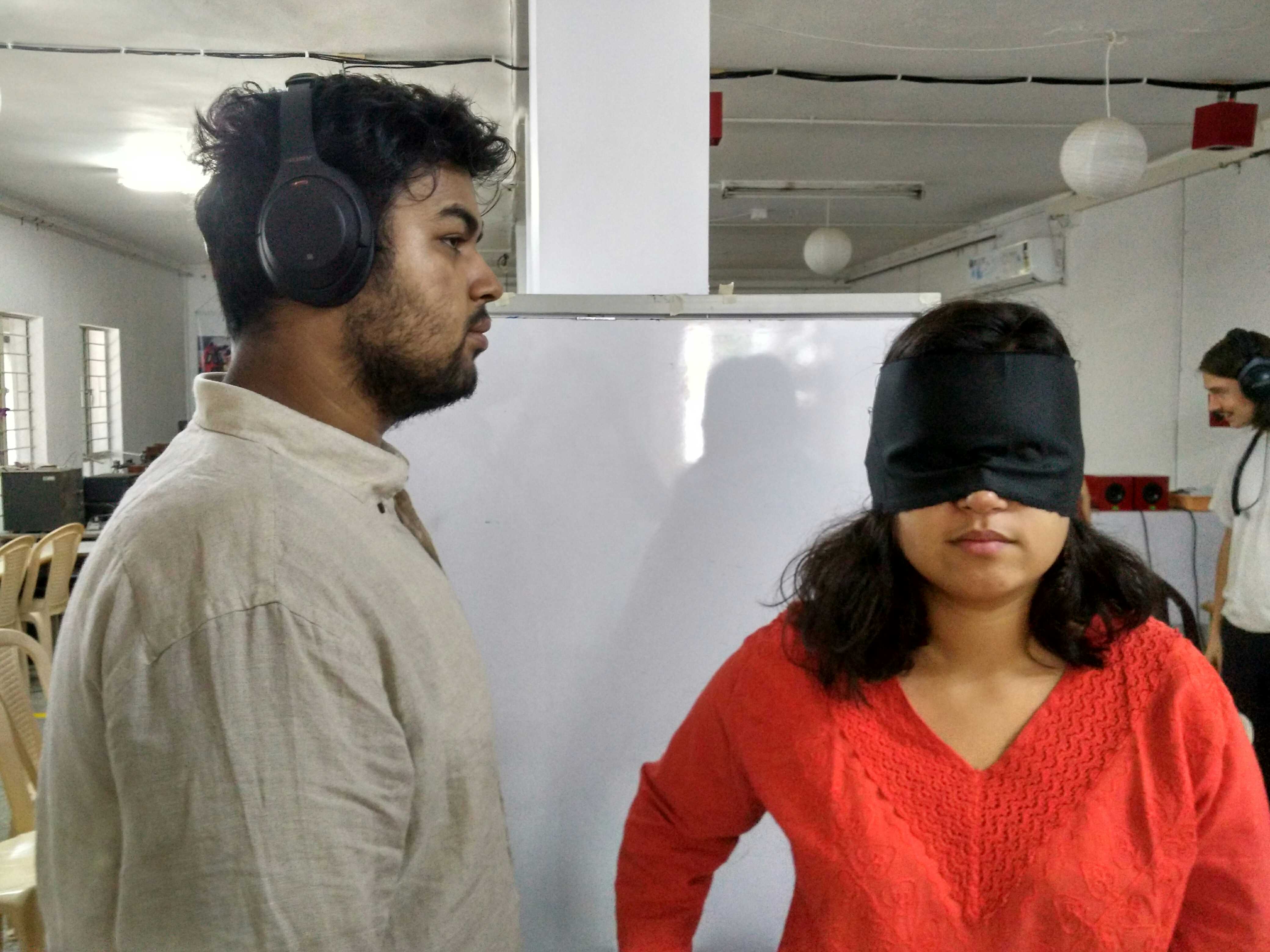
One of us was blind and the other deaf. This was our first assignment. We had to walk around our neighbourhood.
It was interesting to try and use different materials to create earmuffs for soundproofing. We ended up using Styrofoam, held together using ribbons and bands. The deafening wasn’t perfect, but it did the job.
Being partially deaf was a bit unsettling. Normally, I would hear things before I can see them, but now my only input from my surrounding was my vision. I couldn’t hear the vehicles before they zoomed past us, and that made sure I kept looking forward and backward.
Guiding Tarushee was an interesting task. I had to watch her every step, make sure the path is clear for the both of us. I had to be extremely aware of my surroundings, mind not only myself but her motions as well. It felt like we were one brain, communicating between sound and sight to make sense of the environment around us.
At places, I paused and tried to guess the sounds that Tarushee might be hearing. I named those sounds out to her, and she replied with a nod or a shake of her head. It was as if my mind was attempting to create a soundscape in my head based on her replies. It was trying to fill in the void where the usual inputs arrive. It was exaggerated for some reason.
There was a point where I saw a building under construction, but couldn’t tell what kind of work was happening at that moment. So I asked her what sounds she was hearing, and she signalled masonry. There’s so much context that sound can provide. You can hear someone’s footsteps coming up the stairs before you can see them walking into the room. It feels almost like a superpower we always tend to take for granted.
– Vedant
I was the blind person in this exercise and my partner was the deaf one.
Both of us walked from N6 campus to N5 campus albeit with great difficulty. The one emotion that stuck with me throughout this walk happened to be terror. I could hear the traffic around me but could not figure out exactly how close the vehicles were initially. This fear of knowing I could fall on the road any moment and be squished by a car made me really cautious but also made me briefly forget to actually use this opportunity to listen to sounds that I usually end up ignoring. There were multiple occasions where I found myself tripping on the uneven road but also times where I could predict a pothole in the road by how my partner’s hand was moving. I could also tell exactly when the hum of generator started or stopped as we moved around as I wasn’t distracted by my sight.
I could hear people mocking us too, understandably so. I feel that I couldn’t establish the trust that I needed to with my partner as fewer words were exchanged between us. Although the silence that was between us made me hear other sounds like insects, vendors on the road, footsteps, random shuffling of things in the roadside stores and many more much clearer in the brief moments that didn’t consume me with terror.
– Mriganka
Stuttering and stumbling at first, trying to desperately grab onto anything that would tell me where I was where I was where I was where I was where I was. I was fixated on knowing where I was landing up, where I was going, trying to fit what I knew to what I was hearing.
I
‘It’s so nice to be able to hear, I can tell what’s going to happen before it’s going to happen.”
I grossly underestimated how hard this feat was going to be. I completely forgot Ved would not be able to hear, thinking that relying on his eyes alone was all the information he needed to guide me. Hence, I was completely dependent on him, when I could have served as just as much of a guide as he could have.
V: “The worst past for me was not being able to tell where the traffic was coming from”
T: “But I could hear how narrowly we missed brushing past them!”
II
“And suddenly it’s so much, all at once. How did I get used to this?”
I realized I didn’t really mind not seeing. I was thinking about temperature and light, how it naturally guides us. There were some places that felt down-hill/ up-hill, just because of the light. Certain shadows played across my eyelids, despite the black cloth covering them.
The biggest factor in this experience was the person who was guiding me. There was complete trust.
III
“You’re lucky you’re blindfolded so you can’t see all the funny looks we’re getting”
“oh, one is blind folded and one is deaf… (stranger proceeds to throw me off with more clicking and hooting”)
Where other vehicles and their riders stopped to stare or slowed down, the cruelty in this person’s voice took me by surprise. Or maybe I imagined it, knowing exactly how ridiculous the entire exercise must have looked in that moment. It made me think about how the blind navigate the public transport, being guided from one pace to another and how futile it is to bombard them with so much noise pollution, amidst an already bustling and loud cityscape. What more could be explored in giving information, without the use of sound or sight? How would we use temperature, touch, change in body posture, taste and every other bodily function imaginable that connects us to the world around us?
IV
Rediscovering the familiar– Shouldn’t people roam around their homes blindfolded more often?
You think you know where everything is, just like how you know you can type without having to look at the keyboard on a smartphone. As you imagine yourself navigating the map of your bedroom in your mind, you begin to pay more attention to the reasons you placed an object (your bed, your favourite mug, an extension cord) where it is, or even why you didn’t place it there. You begin to get an incredibly personal sense of the space you have outfitted to suit YOUR needs.
As you shift from your living room to your bathroom, you notice more than just the different doors. A narrower, colder space maybe, the cooing of pigeons outside the small window, through which you can also hear the whistling of the neighbour’s pressure cooker in the early morn. The lingering smell of soap mixed phenyl and maybe even a visible feeling of disgust.
M: “I had no sense of time passing, you reach a point when you relax and you finally begin to hear” How was sound really integrated into your surroundings instead of just being an accompaniment? It made me think about the kinds of sounds we create and add to our daily lives, while slowly noticing less of organic sounds that were already a part of our lives to begin with. What are the sounds we can bear to ignore? How is it so easy to tune out or be more attuned to some sounds more than others?
– Tarushee
I think for the most part of the exercise was easy, at least for me. Even after covering my ears with cotton and headphones I was still able to listen to all the cars passing by.
Helping my blindfolded partner cross the road was a task for sure. People did look at us funny which was part of the experience But honestly I though the whole exercise was just mundane walking, maybe because my headphones were not working.
– Jodha
The challenges and responsibility you’re faced when guiding a blindfolded person are quite a burden. Especially when you are deaf. First of the way of communication completely changes. You are communicating in one direction with speaking and get the response in gestures and behavior. You can completely tell if the person you’re walking with is trusting you or if he/she is scared. It is your sense of vision that he/she has to rely on. In terms of terrain the response you get again can change very fast. While being safe and secure on concrete, the expression of the blind person completely changed after doing her first step on soil to worried and careful.
– Ulrich